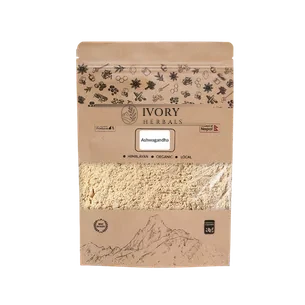
Ayurvedic root botanical
Ashwagandha
BulkWholesalePrivate labelWhite label
Bulk ashwagandha powder is usually ground Withania somnifera root, sold either as a whole-root powder or as a standardized extract. Before buying, confirm the plant part, the form, how withanolides are measured and what the COA covers, because those four points decide whether the material suits your formula and your label.
By the Ivory Herbals team · October 4, 2026 · 7 min read
Ashwagandha has traditionally been used as a root herb, and most U.S. brands specify root-only material. Some extracts on the market include leaf, which can change the chemical profile and the way the ingredient is described on a label. Retailers and marketplaces increasingly ask brands to confirm the plant part.
When you buy bulk ashwagandha powder, ask the supplier to state the plant part on the specification sheet and COA, and make sure your label matches it. "Ashwagandha (Withania somnifera) root powder" is a clear, accurate identity statement.
Whole-root powder is the dried root milled to a fine powder. It is the simplest form, works well in capsules, tea blends and food products, and is labeled by weight of root. A standardized extract is concentrated using a solvent and then tested to a target level of marker compounds, typically withanolides.
Neither is better in every case. Powder suits brands that want a traditional, minimally processed ingredient and simple labeling. Extracts suit formulas where a smaller serving size or a stated marker level is important. The choice affects cost, capsule count and what you can truthfully print on the label.
For extracts, ask for the extraction solvent (commonly water, ethanol or a mixture), the extract ratio and whether any carrier or excipient has been added. These details affect how you list the ingredient and whether the material suits a clean-label product. A brand that has documented these answers is also better prepared for retailer and marketplace questionnaires.
Withanolides are a group of naturally occurring compounds used as quality markers for ashwagandha. Extract specifications often state a minimum percentage. Whole-root powder usually contains a much lower natural level, and many powder suppliers do not standardize at all.
The test method matters as much as the number. HPLC methods measure specific withanolides individually, while some older gravimetric or spectrophotometric methods give higher totals that are not directly comparable. If two suppliers quote very different percentages, ask which method each one used before comparing prices.
A certificate of analysis should match the lot you receive and come from a qualified lab. For ashwagandha, these are the questions worth asking up front.
Ashwagandha powder is hygroscopic and can clump if it absorbs moisture. Store it sealed in a cool, dry place away from direct light, and reseal partial bags promptly. Rotate stock by lot and best-by date, and keep the COA on file against each lot number for traceability.
If you encapsulate or blend in-house, record the lot number of each ingredient on your batch record so you can trace any finished product back to its source material.
Ashwagandha sold as a dietary supplement needs a Supplement Facts panel, a statement of identity naming the plant part and a domestic address for the responsible company. Avoid disease claims; any structure/function statement must be truthful, supported and paired with the DSHEA disclaimer. Some brands also add cautionary statements on pregnancy and medication use. This is general information, not legal advice.
Physical specifications matter as much as chemistry when you run ashwagandha through a capsule machine or blend it into a drink mix. Mesh size describes how fine the powder is: finer powders fill capsules more evenly and disperse better in liquids, while coarser powders flow more freely but can separate in blends. Agree on a mesh specification before ordering and check it against the COA.
Color and odor are simple, useful checks at receiving. Ashwagandha root powder is typically a light tan to beige with an earthy smell. A noticeably different color, a musty odor or visible clumping can signal a different plant part, age or moisture problem and is worth querying before the lot goes into production.
If you blend ashwagandha with other botanicals, test a small batch first. Different powders have different densities, which affects capsule fill weight and the accuracy of the amounts declared on your Supplement Facts panel.
Ivory Herbals LLC, based in Dallas, Texas, stocks ashwagandha in Dallas, TX inventory and ships U.S.-to-U.S. to brands, co-packers and retailers. If you would rather launch a finished product, private label and white label options are made in an ISO 22000 / GMP-certified partner facility.
Request a quote and we will reply within 48 business hours with availability and documentation for your review.
Powder is dried, milled root. Extract is concentrated with a solvent and usually standardized to a stated withanolide level. They differ in serving size, cost and label wording.
Many U.S. brands specify root-only material to match traditional use and retailer expectations. Confirm the plant part on the spec sheet and label.
Different test methods give different results. HPLC figures are typically lower and more specific than older gravimetric or UV methods, so compare like with like.
Create a business account in two minutes. Send inquiries right away; prices unlock once you are approved.